Posts

Experimenting with Music Performer Excerpt 3 Commentary

For my "hard" excerpt for the Experimenting with Music Performer Excerpt Three, I selected measures 59-102 in Incantations. The main performer technique I focused on for this excerpt was rhythm—while for my other excerpts, rhythm was obviously a concern, there are many more challenging rhythmic ideas in this excerpt, hence my emphasis on it. For example, there are several key changes, such as in measure 71 when it swaps to 2/4 time briefly, and in measure 90, where it swaps to 5/4 time from measure 89, which had just swapped to 3/4 time. A sudden switch between time signatures is hard to keep track of rhythmically, so I needed to play that perfectly in order to preserve the integrity of the piece. There are also syncopated rhythms that were not present throughout other excerpts, such as in measures 63-64, and throughout 79-89, that need to be played perfectly as well. 
Music Creation Excerpt 3 Commentary

 As mentioned before (twice now), my stimulus piece is Tobu's Candyland. For part three of my Experimenting with Music Creation Excerpt 3 Commentary, I have finished the main melody and the simple drum pattern. The third component I will be adding to my composition is lots of percussive elements. For the second component of my composition, I added a simple drum beat as a base, much like Tobu does in his own works. The simple drum beat, as can be heard in the second excerpt, is composed of a hi-hat, clap, and 808, which seeks to keep the groove and make the beat "hit hard." I was planning to add lots of little percussion, such as a triangle; particularly lots of I was also thinking of adding a kick to compliment the 808, since the 808 in my composition is keeping the tempo rather than kicks like in the original composition. As mentioned in my second commentary, I find Tobu's drum beats to be rather dry, so I can improve on that by adding percussion. 

Experimenting with Music Performer Excerpt 2 Commentary

  For my medium difficulty excerpt for the experimenting with Music performer section, I selected measures 11-47 in Incantations. While this excerpt is rather basic, staying in-tune and acting as a musical drone in an actual orchestral setting is fairly difficult. I need to make sure I am always on top of the beat. I also need to make sure to incorporate varying dynamics in my performance: In measure 20 for example, it reads mezzo-forte, then in measure 22-24, it increases in volume to forte, then goes back down to mezzo-forte. In measure 29, it then goes to “pp,” or pianimissio. All this goes to say that I should emphasize dynamics. There is also cases of ritardando in the excerpt, such as from measures 35-36, and near the end, where it says “molto rit for measure 42, so I need to make sure to slow down accordingly when those measures pop up. There are also time signature changes, so I also need to be aware of that when playing.

Music Creation Excerpt 2 Commentary

  As mentioned before, my stimulus piece is Tobu’s Candlyand. For part two of the experimenting with Music Creation Excerpt 2 Commentary, I have moved on from melodies, and will now experiment with a strong drum beat. For every Tobu song, in order to keep the tempo of the song, he almost always uses a simple, strong EDM drum pattern. Some common drum patterns that occur throughout his song are a kick on every “one” of the beat, a snare on every “two” of the beat,” and a fairly standard two-step hi-hat pattern throughout the song, in order to keep the tempo. Another common element to his drum beats are the use of open hats and risers. I will incorporate the latter two into my composition, but I will change the traditional drum pattern Tobu essentially copy pastes into every song. Firstly, I think trap drums could sound interesting over the melody, especially with a hard-hitting 808. I can then use the kick to compliment the 808, so instead of the kick driving the tempo, the bass is....

Exploring Music in Context Section 3: AOI 1

Image
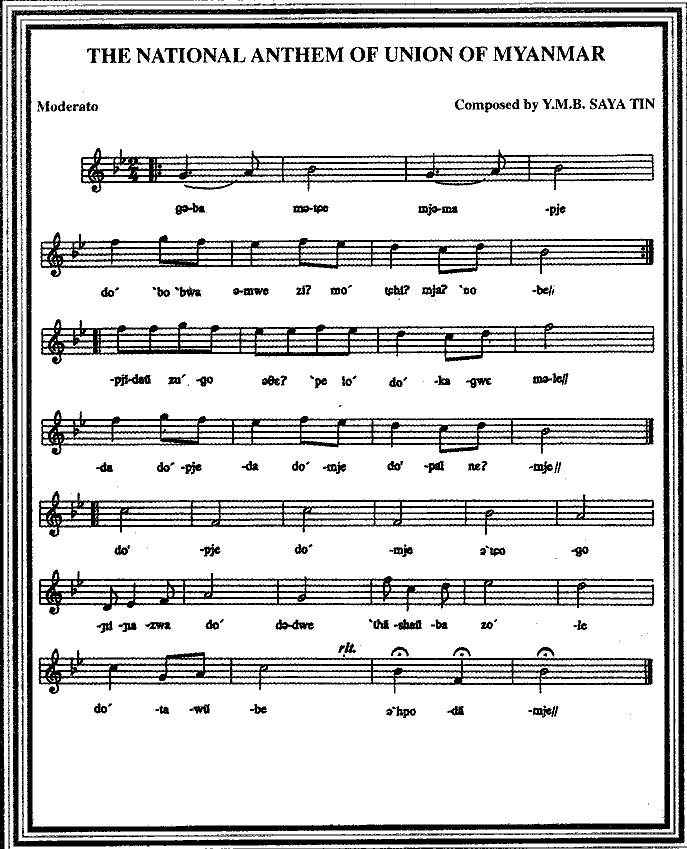
Score:  For my Exploring Music in Context Section 3: AOI 1 recording, I recorded Myanmar’s national anthem Kaba Ma Kyei, or “Till The End of The World.” Firstly, I wanted to do the lyrical content of the piece justice in my recording, as the lyrics are completely centered around bringing love and freedom to Myannar, and vowing to preserve its precious land. This creates a very loving and warm tone, and I wanted to replicate the same tonality in the Double Bass by playing very expressively. One way I was able to do that throughout the piece is by incorporating a lot of vibrato—not only to mimic a soloist or choir’s voices that could sing the piece, but also because on an instrument, the piece sounds very dry without vibrato.  Since the score is written in treble clef, this means I cannot play as a double bass might play it, and instead need to play as a cello would. The tone cannot be too deep, so that is why I am pretty sure that I did not use the low E string a single time—I ...

Exploring Music in Context Section 1: AOI 1

Image
For my Exploring Music in Context Section 1: AOI 1, I decided to change up my stimulus piece, as the Indonesian national anthem proved difficult to find sheet music for. Since there are also multiple different recordings for different versions of the piece online, I thought it would be best to change to a similar piece—Myanmar’s national anthem Kaba Ma Kyei, or “Till The End of The World.”  The official translation of the lyrics is:  Accompanied with justice and freedom; our nation, our motherland. To bring peace to all people; the nation having equal right and pure policy, our nation, our motherland. Let us preserve with vow for perpetuity of our heritage of the Union. As long as the world exists, we love Myanmar, the true heritage of our ancestors. We shall safeguard the Union by sacrificing our lives. This is our nation, our motherland and our own land. Let us serve unitedly for the interest of our nation, our motherland. That is our duty for the precious land. Kaba Ma Kyei...

IB Music Performer Category

Image
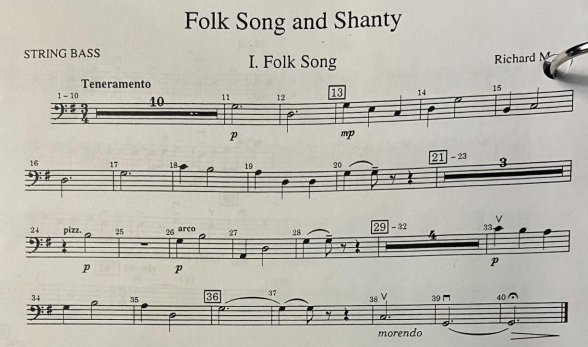
  Performer Category For my first recording, I decided to use Folk Song and Shanty, measures 1-40 as my “easy” excerpt. The main performer technique I decided to focus on for this excerpt is phrasing. As you can see with the excerpt, there are a lot of measures of rest.  Although this looks very simplistic (and it is), phrasing is a big part of playing this excerpt well. Playing too “static” does not complement the piece well, so it is important to pay attention to phrasing. For example, measures 13-20 are meant to be played grandiose, and this is also evident during measures 26-28, when you resume arco. Another measure where phrasing is important is measures 38-40, where the bass part slows down by quite a bit in order to get ready for “Shanty.” Morendo, the musical term written below, means “dying” or “dying away,” so I had to be careful with not only my tempo, but also dynamics. 

Experimenting with Music Creation Excerpt 1 Commentary

My stimulus piece is Tobu's Candyland. Tobu's songs are very distinctive. main melodies are usually not too melodically complex, hence my decision to use a simple 5 bar loop. He usually uses major keys to write his music, and his songs are always very bubbly, catchy, and uptempo. For Candyland, he composes in E major, and uses a tempo of 110. I have two main takeaways from the stimulus. The first aspect of Candyland I decided to incorporate into my composition is to compose an uptempo composition with a strong beat. I decided to crank up the tempo to 138 for my composition, and plan to use a strong drum beat. The second takeaway is the addictive melody component:  I thought I could get the same "addictive" melodies by composing in Eb minor, since I already had the melodic idea before starting my composition. My melody revolves along a simple 5-bar call and response structure, with a homophonic texture, similar to the stimulus piece. 

Experimenting with Music Performance

  The pieces I chose for the Experimenting with Music Performance are Folk Song and Shanty, and Incantations, both composed by Richard Meyer. The reasons for choosing these pieces are simple—at the time of selecting my “Music performance” pieces, these were the only two pieces I was working on for string orchestra. However, we just started learning a score for “Coco,” so that may be my third piece for the experimenting with music performance section. Although I know I am capable of playing more challenging pieces, the pieces provided in string orchestra help to reinforce fundamentals, and some sections of the pieces are also pretty difficult. Folk song and Shanty is in the British folk song style, a style of music I am not at all familiar with. For my excerpt from folk song and shanty, I re-selected measures 1-37. As for performance techniques I can use in my composition, focusing on articulation and spacing is important, as that translates to making sure my composition has space i...

Experimenting with Music Creation Rationale

  For the music creation rationale, I chose Tobu (styled as 7bou)’s Candlyand. Tobu, an electronic music producer from Latvia, creates EDM songs with addictive melodies, and always exerts positive energy to his listeners. His music prominently features bubbly and melodic synths, and usually minimal drums, allowing his melodies to remain the defining feature of his song. He usually uses major keys to write his music, hence the “catchy” nature of his songs. In Candyland, and with many other songs of his I listened to, he usually uses 110+ BPM, so most of his songs are uptempo.  I usually do not listen to electronic dance music—I listen to a lot of different music genres, but electronic dance music is not a genre I am familiar with at all. I enjoyed his songs quite a bit, and his version of “feel good” music is one I would listen to in the background while working. Although the music originates from Latvia, it was surprising to see the global reach Tobu has, since his biggest sin...

IB MUSIC ANALYSIS AOI 4

  First Piece: Medium: Voxes, synths, piercing sine waves, assorted drum sounds/percussion, random sound effects, sirens, synth bass, bells. Melody: Not very melodic / No melody Harmony: Practically none.  Meter: 70 bpm  Form: Not much structure, goes from series of noises to the other.  Style: Electronic music, unconventional. Musique concrete: a type of music composition that utilizes recorded sounds as raw material. Sounds are often modified through the application of audio effects and tape manipulation techniques, and may be assembled into a form of montage. It can feature sounds derived from recordings of musical instruments, the human voice, and the natural environment as well as those created using synthesizers and computer-based digital signal processing. Compositions in this idiom are not restricted to the normal musical rules of melody, harmony, rhythm, metre, and so on. It exploits acousmatic listening, meaning sound identities can often be intentionally o...

AOI3 Section 2: Process

Image
 For my composition project, I decided to use Breath of the Wild's Main Theme, or simply known as "Track 1" in the game's track list, not only because Breath of the Wild is one of my favorite games of all time, but also because I consider the Main Theme (along with the rest of the soundtrack) to be iconic. Melodically, the piece is very complex, but I thought I could tackle the challenge. In order to stay true to the original purpose of the stimulus piece, I attempted to borrow the exact same chord progression, with some minor changes. The original score I used did not have the most accurate chords, so I had to figure a lot of it out by myself. I also took out some of the more complex chord progressions in the piano part—either due to my limited technical skills in MuseScore, but also to give room to the Double Bass solo; for example, in measure 29 of my composition, it looks something like this:  Whereas in the original, it looks something like this: Given the contex...

Exploring Music in Context Creation Plan

Medium: Piano and Double Bass Tonal Center: Goes through many different key changes, switches between major and minor keys. Piece starts in Eb Major, ends in C Minor.  Time Signature: 3/4 Tempo: 101 BPM Texture: Polyphonic Form: 32 bars.  Melodic Devices: Mostly conjunct, but there are also some disjunct intervals in the piece. Compromised of 8-bar measures. Uses the pentatonic scale.  Main Harmonic Ideas: Borrowed Chords -Given that there are so many key changes, it's often hard to tell what key it's in -There are borrowed chords being littered throughout the song: the most prominent example is the chord being played last: for instance, despite being a D minor chord, there is a B-natural being played, which is an accidental.   

Exploring Music in Context Section 1: AOI 3

Image
Analyzing Video Game Music: Breath of the Wild’s Main Theme https://www.youtube.com/watch?v=cPWBG6_jn4Y The music I will be analyzing is Breath of the Wild’s “Main Theme”, simply listed as “Track 1” in the official soundtrack. Composed by Manaka Kataoka in early 2016, this was initially written for Breath of the Wild’s trailer at the E3 of the same year. This is a super unique piece that I’ve never heard anywhere else, and is one of my favorite video game themes to this day. Although it utilizes an European orchestral theme, modern synthesizers and ancient traditional instruments, such as Shinobue and Ehru, are also blended into the composition.  The piano opens and closes the piece; European orchestral instrumentation such as strings, horns, and percussion are also present in the tune. There is some special instrumentation, with the Shinobue, a Japanese flute is traditionally made of bamboo and characteristically gives off a sweet, high registered sound, and an ehru , a double ...

Music Analysis Journal

  Personal Context: includes music that has significance to the student and that they are familiar with Local context: this includes music that has local significance, but that may be unfamiliar to the subject Global Context: this includes unfamiliar music from different societies and cultures. -in the name: distant global region that was not previously accessible to the student.  Roles: Researcher, Composer, Performer Defying Gravity from Wicked  Melody: piano, drum kit, trombone, strings, 2 vocalists with a chorus  -mostly sung by Idina, high range or tessitura, movement by leaps in  -Harmony: in the key of G Major, uses G major diatonic chords. Could be thought of as being in D mixolydian. -Texture: Homophonic: Main melody with supporting voices -Meter: tempo is 136 bpm 4/4 time Form: Verse, Chorus, Verse, Chorus, Bridge, Chorus Style: Broadway Musical Context: Personal or Local, meant to entertain and accompany a theatrical performance Vocal: heavy use of ...

IB Music 10/5/21

  Texture: Call and Response  Ostinado: a short musical pattern that is repeated throughout a work or a major section of a composition (Pacabell’s Canon) Context: Purpose of Music  -Ceremonial Music (Coronation) -Sacred Music  Chamber Music: small groups, meant to be played in a “Chamber.” -Many different types of bands: Jazz Bands, Bluegrass Bands, etc.  Create 3 new pages on blog 1st one: “Area of inquiry One - Music for social-cultural and politics. “ This area focuses on music that expresses and communicates social and cultural messages, conveys political ideas and/or helps preserve social and cultural traditions. 2nd one: “Area of Inquiry 2: Music for listening and performance” This area focuses on music that expresses and communicates intrinsic aesthetic values. Such music is sometimes referred to as absolute music. Area of Inquiry 3: Music for dramatic impact, movement and entertainment This area focuses on music for supporting choreography, dance, f...

Elements of Music

 Section 1: Triads Major Triads: Major third, perfect 5th      Minor Triads: Minor third, perfect fifth      Augmented Triads: major third, aug. fifth Diminished Triads: minor third, diminished fifth Inverting Chords: changing the position of the notes 1st inversion: bass note is now 3rd of the chord 2nd inversion: 5th is the bass note of the chord Section 2: Seventh Chords: -4 notes total in the triad: triad + seventh -Major triad and a minor 7th = dominant 7th chord -major triad + major 7th = major 7th chord -minor triad + minor 7th = minor 7th chord -fully diminished 7th chord Section 3: Diatonic Triads: every major and minor scale has seven specials triads which are found from that scale's notes. -pattern for major scales: maj, min, min, maj, maj, min, dim, maj -Natural minor: min, dim, maj, min, min, maj, maj, min -Harmonic Minor: min, dim, aug, min, maj, maj, dim, min -Melodic minor: min, min, aug, maj, maj, dim, dim, maj  Section 4: Texture...