Posts

Experimenting with Music Performer Excerpt 2 Commentary

  For my medium difficulty excerpt for the experimenting with Music performer section, I selected measures 11-47 in Incantations. While this excerpt is rather basic, staying in-tune and acting as a musical drone in an actual orchestral setting is fairly difficult. I need to make sure I am always on top of the beat. I also need to make sure to incorporate varying dynamics in my performance: In measure 20 for example, it reads mezzo-forte, then in measure 22-24, it increases in volume to forte, then goes back down to mezzo-forte. In measure 29, it then goes to “pp,” or pianimissio. All this goes to say that I should emphasize dynamics. There is also cases of ritardando in the excerpt, such as from measures 35-36, and near the end, where it says “molto rit for measure 42, so I need to make sure to slow down accordingly when those measures pop up. There are also time signature changes, so I also need to be aware of that when playing.
Music Creation Excerpt 2 Commentary

  As mentioned before, my stimulus piece is Tobu’s Candlyand. For part two of the experimenting with Music Creation Excerpt 2 Commentary, I have moved on from melodies, and will now experiment with a strong drum beat. For every Tobu song, in order to keep the tempo of the song, he almost always uses a simple, strong EDM drum pattern. Some common drum patterns that occur throughout his song are a kick on every “one” of the beat, a snare on every “two” of the beat,” and a fairly standard two-step hi-hat pattern throughout the song, in order to keep the tempo. Another common element to his drum beats are the use of open hats and risers. I will incorporate the latter two into my composition, but I will change the traditional drum pattern Tobu essentially copy pastes into every song. Firstly, I think trap drums could sound interesting over the melody, especially with a hard-hitting 808. I can then use the kick to compliment the 808, so instead of the kick driving the tempo, the bass is....

Exploring Music in Context Section 3: AOI 1

Image
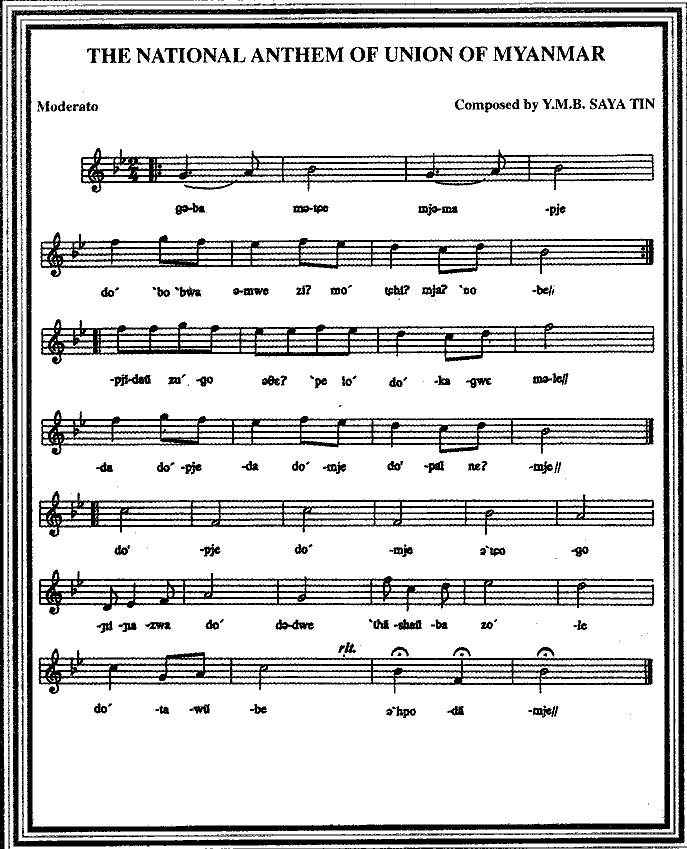
Score:  For my Exploring Music in Context Section 3: AOI 1 recording, I recorded Myanmar’s national anthem Kaba Ma Kyei, or “Till The End of The World.” Firstly, I wanted to do the lyrical content of the piece justice in my recording, as the lyrics are completely centered around bringing love and freedom to Myannar, and vowing to preserve its precious land. This creates a very loving and warm tone, and I wanted to replicate the same tonality in the Double Bass by playing very expressively. One way I was able to do that throughout the piece is by incorporating a lot of vibrato—not only to mimic a soloist or choir’s voices that could sing the piece, but also because on an instrument, the piece sounds very dry without vibrato.  Since the score is written in treble clef, this means I cannot play as a double bass might play it, and instead need to play as a cello would. The tone cannot be too deep, so that is why I am pretty sure that I did not use the low E string a single time—I ...

Exploring Music in Context Section 1: AOI 1

Image
For my Exploring Music in Context Section 1: AOI 1, I decided to change up my stimulus piece, as the Indonesian national anthem proved difficult to find sheet music for. Since there are also multiple different recordings for different versions of the piece online, I thought it would be best to change to a similar piece—Myanmar’s national anthem Kaba Ma Kyei, or “Till The End of The World.”  The official translation of the lyrics is:  Accompanied with justice and freedom; our nation, our motherland. To bring peace to all people; the nation having equal right and pure policy, our nation, our motherland. Let us preserve with vow for perpetuity of our heritage of the Union. As long as the world exists, we love Myanmar, the true heritage of our ancestors. We shall safeguard the Union by sacrificing our lives. This is our nation, our motherland and our own land. Let us serve unitedly for the interest of our nation, our motherland. That is our duty for the precious land. Kaba Ma Kyei...

IB Music Performer Category

Image
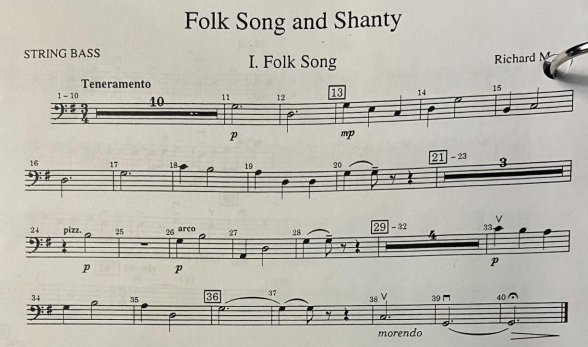
  Performer Category For my first recording, I decided to use Folk Song and Shanty, measures 1-40 as my “easy” excerpt. The main performer technique I decided to focus on for this excerpt is phrasing. As you can see with the excerpt, there are a lot of measures of rest.  Although this looks very simplistic (and it is), phrasing is a big part of playing this excerpt well. Playing too “static” does not complement the piece well, so it is important to pay attention to phrasing. For example, measures 13-20 are meant to be played grandiose, and this is also evident during measures 26-28, when you resume arco. Another measure where phrasing is important is measures 38-40, where the bass part slows down by quite a bit in order to get ready for “Shanty.” Morendo, the musical term written below, means “dying” or “dying away,” so I had to be careful with not only my tempo, but also dynamics. 

Experimenting with Music Creation Excerpt 1 Commentary

My stimulus piece is Tobu's Candyland. Tobu's songs are very distinctive. main melodies are usually not too melodically complex, hence my decision to use a simple 5 bar loop. He usually uses major keys to write his music, and his songs are always very bubbly, catchy, and uptempo. For Candyland, he composes in E major, and uses a tempo of 110. I have two main takeaways from the stimulus. The first aspect of Candyland I decided to incorporate into my composition is to compose an uptempo composition with a strong beat. I decided to crank up the tempo to 138 for my composition, and plan to use a strong drum beat. The second takeaway is the addictive melody component:  I thought I could get the same "addictive" melodies by composing in Eb minor, since I already had the melodic idea before starting my composition. My melody revolves along a simple 5-bar call and response structure, with a homophonic texture, similar to the stimulus piece. 

Experimenting with Music Performance

  The pieces I chose for the Experimenting with Music Performance are Folk Song and Shanty, and Incantations, both composed by Richard Meyer. The reasons for choosing these pieces are simple—at the time of selecting my “Music performance” pieces, these were the only two pieces I was working on for string orchestra. However, we just started learning a score for “Coco,” so that may be my third piece for the experimenting with music performance section. Although I know I am capable of playing more challenging pieces, the pieces provided in string orchestra help to reinforce fundamentals, and some sections of the pieces are also pretty difficult. Folk song and Shanty is in the British folk song style, a style of music I am not at all familiar with. For my excerpt from folk song and shanty, I re-selected measures 1-37. As for performance techniques I can use in my composition, focusing on articulation and spacing is important, as that translates to making sure my composition has space i...